About Quality Assurance Center
The Quality Assurance Center of Mili
University is a fundamental, professional, and academic unit that works to
enhance, maintain, and develop the quality of the university’s academic,
teaching, administrative, and research activities. Through a systematic,
continuous, and plan-based approach, the center evaluates various departments
of the university to ensure that national and international standards are met
and that the quality of higher education is continuously improved and
sustained.
Quality assurance is essentially a
continuous evaluation process of different aspects of a program or system,
which facilitates achieving predefined quality standards and enables institutions
to remain leaders in delivering standard higher education. The concept of
quality assurance initially emerged in economic and commercial sectors but was
later adopted by academic and educational institutions, where specific
standards were defined and implemented to improve higher education quality.
This process was first introduced in 1887 at a university in the United States
and later strengthened in Japan in 1948.
In Afghanistan, quality assurance is
relatively new. It formally began in 2012 (1391 HS) with the establishment of
the Quality Assurance and Accreditation Directorate within the Ministry of
Higher Education. Since then, efforts have been ongoing to enhance university
quality, achieve accreditation, and align with international standards.
The Quality Assurance Center
provides numerous benefits to the university, including improving the quality
of teaching and learning, enhancing the capacity of faculty and staff, ensuring
standard education for students, increasing institutional credibility and
reputation, strengthening academic competitiveness, and promoting
administrative transparency. The center fosters a culture of continuous
improvement and ensures that all university activities are carried out in
accordance with established standards.
Modern demands require academic
institutions to advance through quality and standardized education and to
remain competitive globally. Quality assurance builds academic trust, which is
highly valuable for students, faculty, and society. It also promotes healthy
competition among universities, contributing to the development of a strong
academic environment. Quality is the foundation of sustainability for any
institution, as no organization can achieve long-term success and credibility
without it.
Furthermore, the quality assurance
system provides a clear vision and structured direction for university
activities, helping to prevent ineffective planning. In today’s world, academic
institutions are central to the production, dissemination, and advancement of
knowledge; therefore, quality assurance is a vital necessity. Without it,
institutions cannot deliver standard academic and research services in line
with contemporary needs. The quality assurance framework enables universities
to organize their activities based on defined standards and align with global
benchmarks.
In Afghanistan, the quality
assurance process in higher education institutions is divided into three main
stages: Stage One, Stage Two, and Stage Three (Full National Academic
Accreditation). Universities are required to achieve these stages sequentially
every five years by meeting the relevant criteria in order to maintain and
enhance their academic accreditation. This process serves as an important
mechanism for continuous improvement, institutional development, and alignment
with international standards.
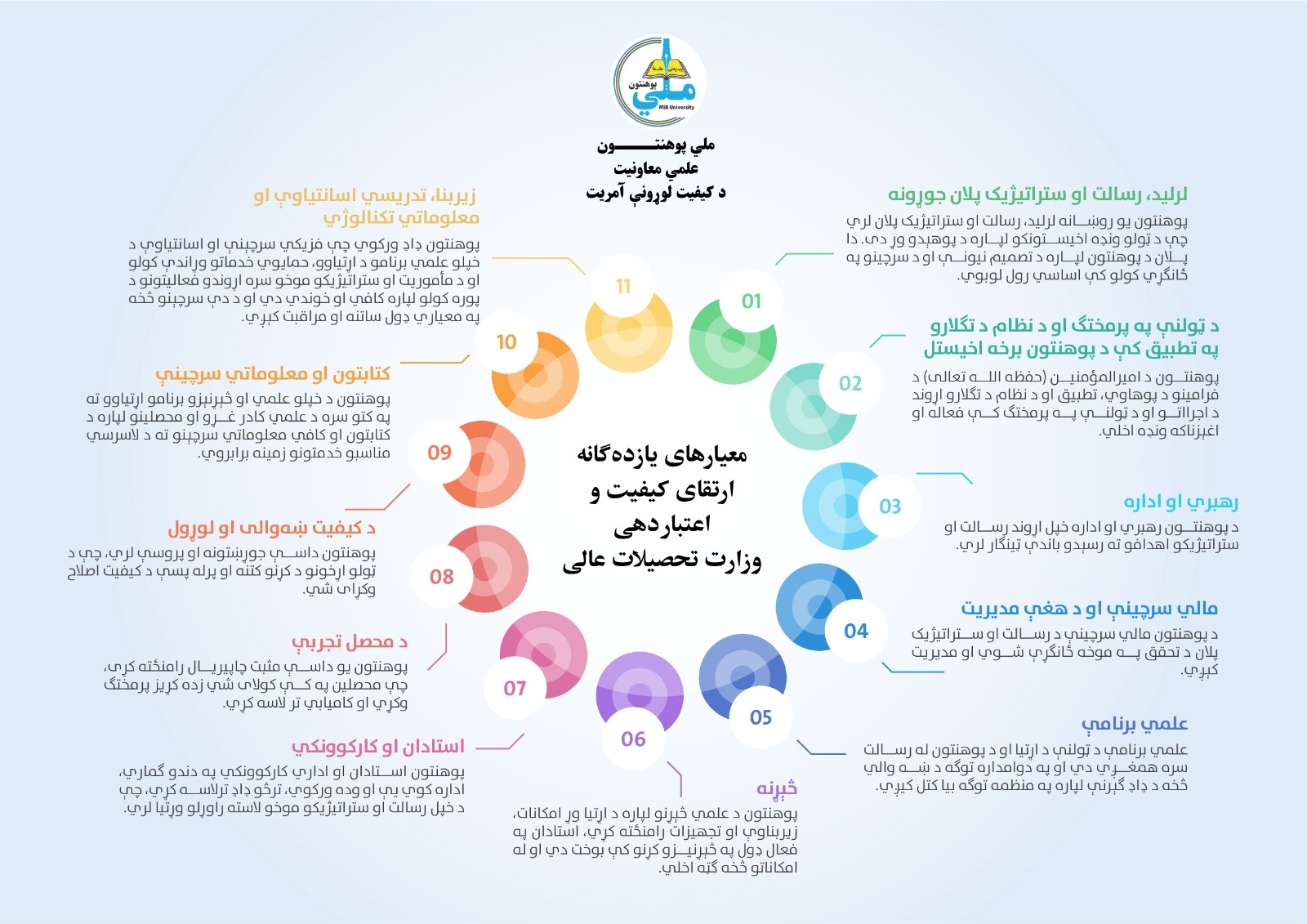
In this regard, Mili University has made significant progress, successfully achieving the first and second stages of quality assurance and is currently taking serious and strategic steps toward obtaining the third stage, which is full national academic accreditation. The Ministry of Higher Education of Afghanistan has defined 11 core standards for different stages of quality assurance, covering all academic, administrative, research, and service aspects of universities and forming the foundation of the accreditation process.